Lumbar Support
The lower back curve should maintain its natural inward curve. Chair backrests with adjustable lumbar support or a small cushion can assist with this alignment.
Our guides translate established workplace setup concepts into accessible language. Every article on this page provides general informational content and is not intended as medical or therapeutic guidance.
Ask a Question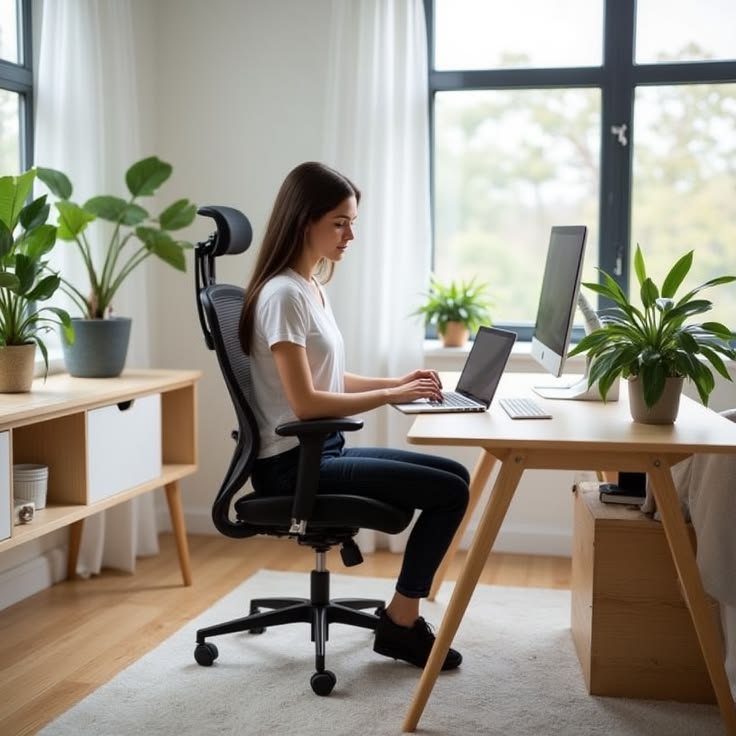
A neutral posture distributes body weight evenly and supports alignment of muscles and joints during seated work. These principles serve as reference points rather than rigid prescriptions.
The lower back curve should maintain its natural inward curve. Chair backrests with adjustable lumbar support or a small cushion can assist with this alignment.
Elbows resting at approximately 90 to 100 degrees when hands are on the keyboard reduce shoulder elevation and forearm tension during typing.
Equipment decisions depend on individual body dimensions, work tasks, and budget. We outline functional criteria rather than specific product endorsements.
Screen top edge at or slightly below eye level, positioned at arm's length distance. Dual monitors should align at equal height with primary display centred.
Flat or slightly negative tilt keyboards keep wrists neutral. Ergonomic mice and trackballs offer alternative grip positions for varied hand sizes.
Adjustable seat height, depth, and backrest angle accommodate different body proportions. Seat pan depth should leave two to three finger widths between seat edge and back of knees.
When feet do not reach the floor comfortably, an angled footrest provides stable support and promotes proper thigh positioning.
Document holders, headset stands, and wrist rests serve supplementary roles. None replace proper desk and chair adjustment as the primary ergonomic foundation.
Regular position changes complement static desk arrangements. These frameworks provide structured intervals for movement during work sessions.
Brief eye rest breaks looking at distant objects
Stand, stretch, or walk for two to three minutes
Extended break with light physical activity
Reflect on posture habits and plan adjustments
A self-paced educational challenge introducing workspace concepts progressively. Each module includes reading material, self-assessment exercises, and reflection prompts.
Learn measurement techniques for desk height, monitor distance, and chair settings. Complete a baseline workspace survey documenting your current configuration.
Explore keyboard tilt, mouse positioning, and alternative input methods. Practice adjustments and record personal observations over several workdays.
Assess lighting conditions, ambient temperature, and acoustic quality in your workspace. Implement one environmental improvement and document its effect on focus.
Integrate movement breaks into your daily schedule. Create a personal reference card summarising your optimal settings for quick review.
Separating evidence-based guidance from popular assumptions helps you make informed workspace decisions.
No single posture suits all individuals. Body proportions, existing habits, and work tasks vary considerably. Neutral posture guidelines provide a starting reference that each person adapts to their circumstances.
Chair price does not determine suitability. Proper adjustment and compatibility with your desk height matter more than cost. A well-adjusted mid-range chair may suit many users better than an expensive model left at default settings.
Alternating between sitting and standing adds variety but does not replace the value of walking breaks and position changes. Combining sit-stand capability with scheduled movement intervals may work well for many people.
Wrist rests are optional accessories. They should support the heel of the palm during pauses, not the wrist during active typing. Correct keyboard height and floating wrist technique often reduce the need for rests entirely.
Each topic is presented as general informational content drawn from widely recognised workplace ergonomics literature and practical observation.
Screen brightness, text size, and viewing distance considerations for extended digital work.
Task rotation and pacing strategies to vary muscle group engagement throughout the workday.
How workspace organisation influences mental focus and task-switching efficiency.
Guidance for managers implementing workspace standards across distributed and office-based teams.
All ergonomics content published by Beautremoveau is general informational material intended for educational purposes. It does not constitute medical advice, diagnosis, or treatment. Individual experiences with workspace adjustments vary. Consult a qualified professional for concerns related to your work environment.